
Communicating with a probe 25 billion kilometers away: the impossible challenge that NASA overcomes every day
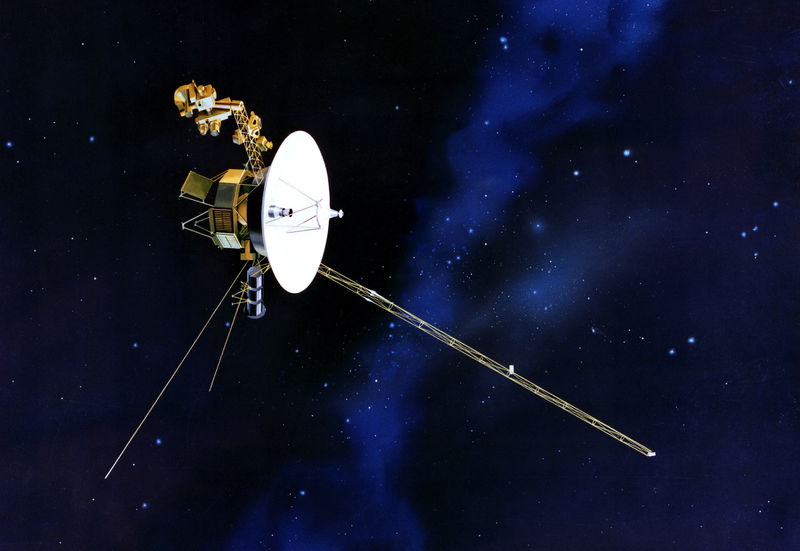

Some numbers are hard to grasp and defy our imagination. Twenty-five billion kilometers, for example. That's the distance between us and Voyager 1 today. It's the man-made object farthest from us in the Universe. And yet, every day, NASA sends commands to this probe, and it responds! How is that possible?
A traveler who set out in 1977 and is still on the road
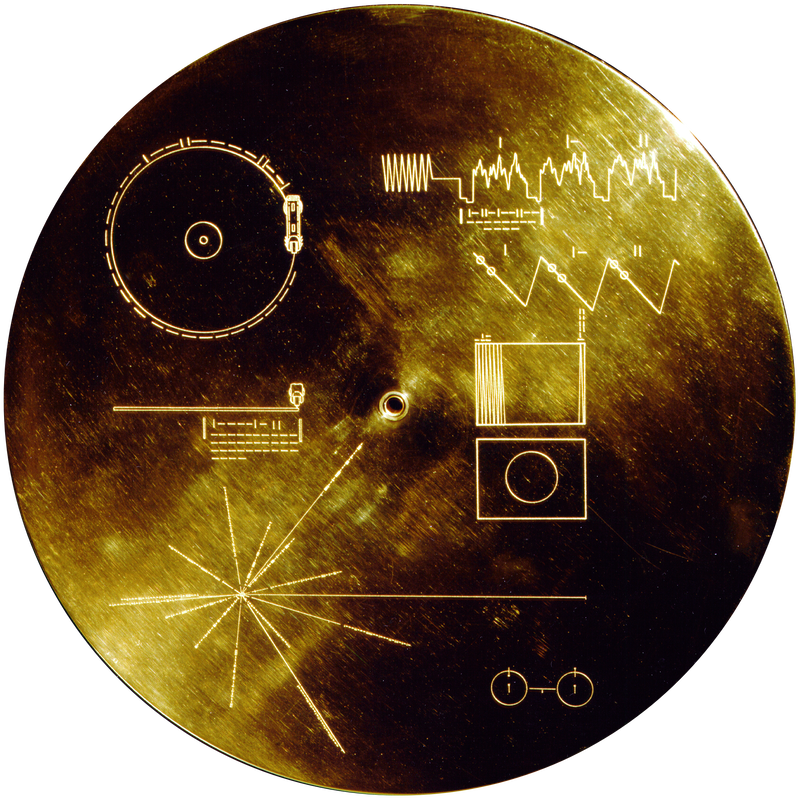
The Voyager 1 probe was launched on September 5, 1977. Nearly 50 years ago! On board, it carries scientific instruments that have led to amazing discoveries, as well as a unique object: the Golden Record, a gold disc engraved with sounds, music, and images representing humanity. It contains, among other things, photos of landscapes and living beings, sound recordings of natural sounds (rain, waves, wind, etc.), welcome messages in several languages, and even classical music. A sample of humanity in a bottle cast adrift in the infinite ocean of space. Just in case an extraterrestrial civilization ever stumbles upon it.
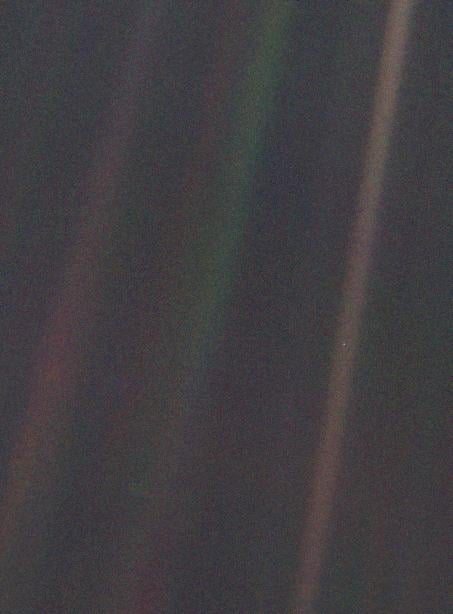
In 1990, while it was "only" 6.4 billion kilometers away from us, Voyager 1 turned its camera toward Earth and took a photo that has become legendary. The Pale Blue Dot shows our planet as a speck of dust suspended in a beam of light. It is overwhelming to think that this tiny dot encompasses all of humanity, its world, and its history: the forests, the oceans, the pyramids, the cities, the first cave paintings, our joys and sorrows, our dreams… When the infinitely vast makes us feel infinitely small.
Since then, the probe has continued its journey. It has left the solar system, crossed the heliosphere (the Sun's bubble of influence created by solar wind), and is now hurtling through interstellar space. And NASA is still in contact with it.
"But I lose my Wi-Fi connection when I move to another room."
That's where things get downright unfair. At home, we lose the signal as soon as we move a little away from the internet router. Yet NASA maintains a stable connection with a probe 25 billion kilometers away. How is that possible?
The first part of the answer lies in the nature of the signal emitted by Voyager 1. The probe is equipped with a 20-watt radio transmitter. That's roughly the same power as a desk LED light bulb or a video game console in standby mode. Not very impressive at first glance.
Yes, but the fundamental difference from our Wi-Fi is that space is empty. Terribly, radically empty. It's actually kind of scary. No air, no walls, no obstacles. There are planets, asteroids, and dust, but at these distances they're so rare that, in practice, space remains almost entirely empty. The signal from Voyager 1 therefore travels through the vacuum of space without encountering the slightest resistance. No concrete walls to absorb it, no other signals to interfere with it. It has been traveling in a straight line, at the speed of light, for decades. There is no faster way to travel.
A signal weaker than a whisper in a storm
The problem is that even in a vacuum, a signal weakens with distance. And by the time it reaches Earth after traveling 25 billion kilometers, it's worn out, which is only natural.
Upon arrival on Earth, the received signal strength is said to be around -150 dBm. If that unit doesn't mean much to you, here are a few analogies. At that level, it's like trying to hear someone whisper in a packed concert hall during a thunderstorm, while everyone else is shouting at the same time. Or like hearing the fluttering of a butterfly's wings from miles away while walking through Times Square in New York.
Compared to the signal from our home internet router, we're no longer even in the same ballpark: while a Wi-Fi signal is already very weak on a human scale, Voyager 1's signal is hundreds of billions of times weaker still. We're at the absolute limit of what's detectable.
Humanity's Big Ears
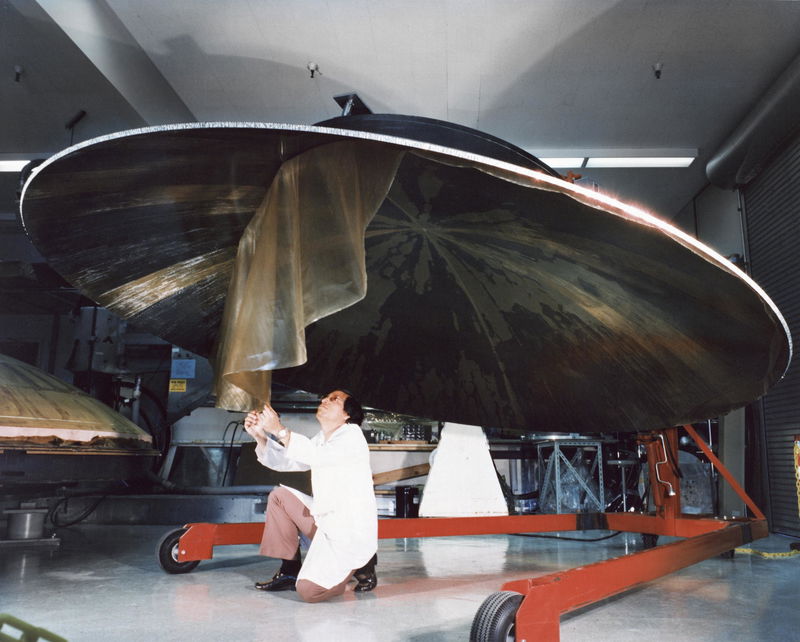
And yet this signal is still usable. To pick it up, extraordinary instruments are needed. NASA uses the Deep Space Network (DSN), a network of three giant antennas spread across the globe: in California (Goldstone), Spain (Madrid), and Australia (Canberra). Why three, and so far apart at that? Because the Earth rotates on its axis, and we want to ensure that at least one antenna is always pointed in the direction of the probe.
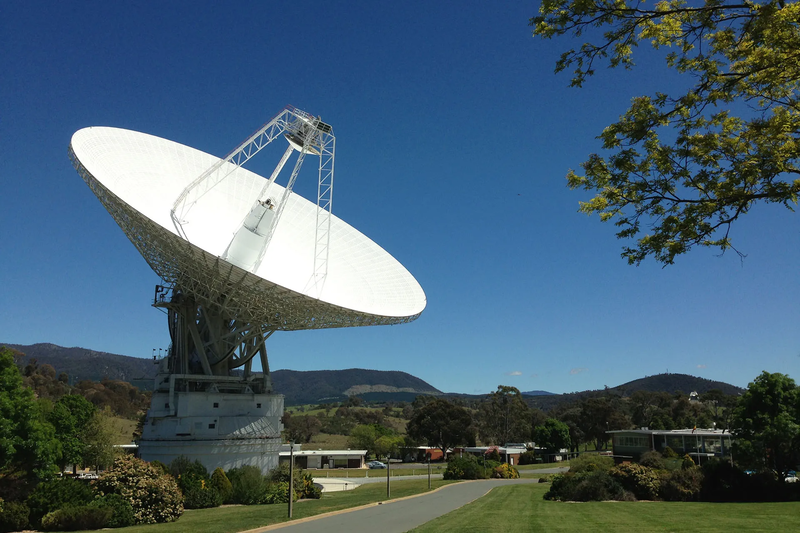
These antennas don't look like the satellite dishes on our roofs. Well, actually, they do. A little, anyway. Except that these are massive structures 70 meters in diameter, which is taller than the Leaning Tower of Pisa! They are aimed with surgical precision to track the probe as it travels. And they're directional: unlike Wi-Fi, which radiates in all directions, these antennas focus their reception within a very narrow cone. Their entire surface, thousands of square meters of polished metal, collects and focuses the rare photons from Voyager 1's signal that have managed to reach Earth.
Cold weather helps you hear better
But having giant antennas isn't enough. You also need incredibly effective digital processing to distinguish the signal from the noise. The signal is the probe's voice, what we want to hear. The noise is everything else: static, interference, but also the electronic noise from the instruments themselves, the small internal fluctuations of the components. So there is external noise, coming from the cosmos and Earth's surroundings, but also noise added by the machine itself, as if the listening ear were constantly generating its own background static.
And then an unexpected enemy comes into play: the heat.
Any hot object emits electromagnetic waves randomly due to the thermal motion of electrons. And it doesn't have to be scorching hot to do so. An electronic receiver at room temperature generates noise on its own, and this noise interferes with the already tiny signal it is trying to read. It's like trying to hear a whisper in a concert hall. Either the person has to speak louder, or the hall has to be silenced. And that's the second option we choose.
The solution, then, is to cool the receiver to cryogenic temperatures, close to absolute zero (-273°C), using liquid nitrogen or helium. At these temperatures, the thermal motion of electrons drops to a negligible level, and electronic noise disappears almost entirely. The receiver is then able to detect faint signals like those from Voyager 1. And everything happens on Earth: the probe simply transmits, and we've built the equipment to listen to it.
A clock ticking, a battery running out
How much longer will we be able to communicate with Voyager 1? The answer lies in two constraints that are becoming increasingly severe with each passing day.
First, the distance. It now takes more than 23 hours for a signal to travel from the probe to Earth. Sending a command and receiving confirmation therefore takes about 48 hours today, and this delay is constantly increasing.
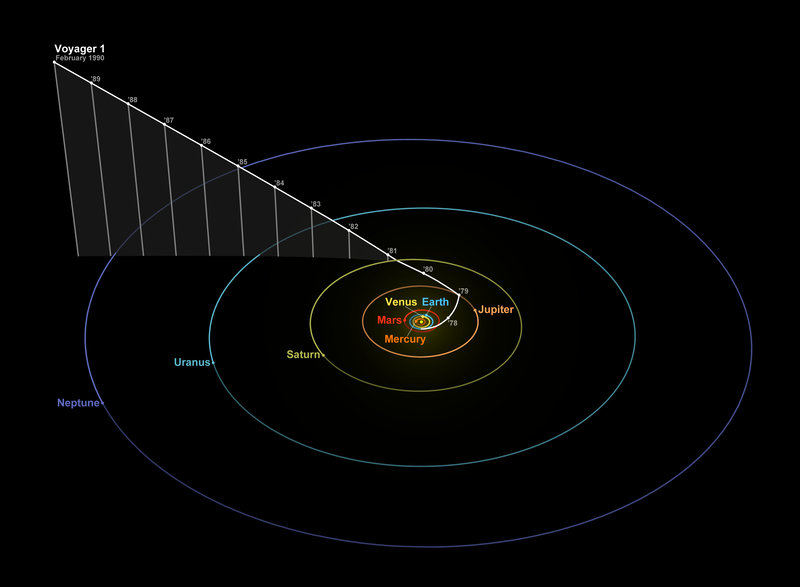
Next, and most importantly, the power source. Voyager 1 doesn’t have solar panels because it is too far from the Sun for them to be effective. It is powered by a radioisotope thermoelectric generator (RTG), a sort of nuclear battery, which harnesses the heat produced by the natural decay of a piece of plutonium-238. This heat is then converted into electricity to power the probe. But this energy source slowly diminishes over time, as the radioactive material decays. The three batteries on board now produce about half as much energy as they did at launch, and this decline is irreversible.
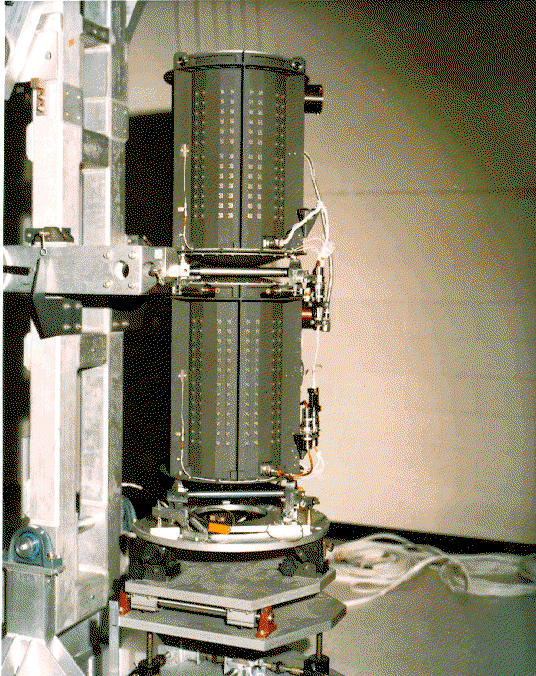
Engineers are therefore gradually shutting down the instruments one by one to preserve what matters most: communication. Current estimates suggest that NASA will be able to maintain contact until around 2025–2030, perhaps a little longer. After that, Voyager 1 will continue its journey alone and in silence.
What it says about us
It's pretty amazing to think that we're still communicating with a machine built in the 1970s (back when computers took up entire rooms) with huge metal ears cooled by helium.
There is also something deeply moving about this story. Carl Sagan, who had convinced NASA to turn Voyager 1's camera toward Earth to take the Pale Blue Dot photograph, liked to remind us that we are, quite literally, made of "star-stuff" and that "the cosmos is within us." To know the Universe is to know ourselves.
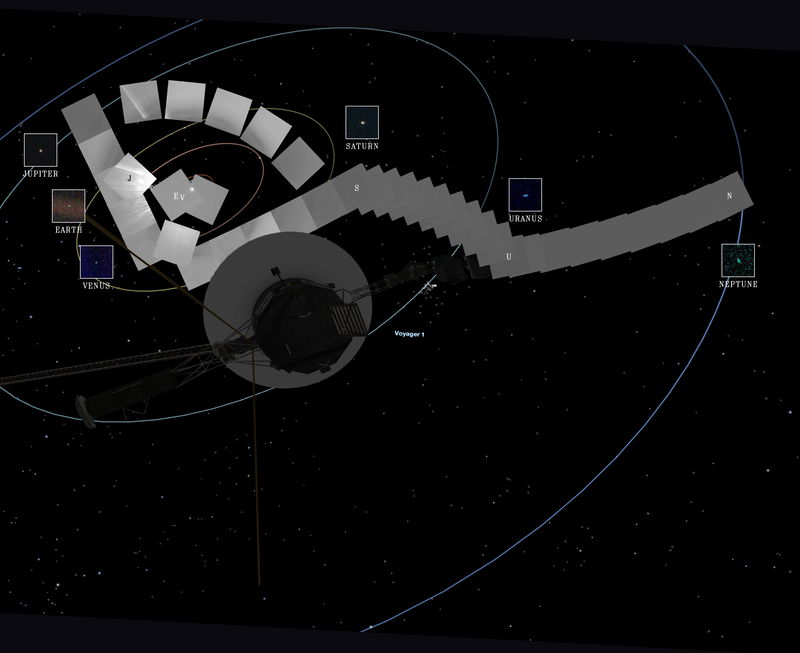
Voyager 1 will continue its journey long after we lose contact with it. Perhaps for millions of years to come. Unless it encounters other forms of "star-stuff"…

Comments
No comments yet. Be the first to comment!